


Invisible Invaders in New Albany: A Technical Guide to Winter Rodent Fortification

As the first hard freeze settles over New Albany and Westerville, the biological reality of Central Ohio’s winter becomes clear: pests do not disappear; they migrate. Among these "Invisible Invaders," rodents—specifically the House Mouse (Mus musculus) and the Norway Rat (Rattus norvegicus)—represent the most immediate threat to the structural integrity and safety of your home.
In our foundational guide, The Silent Threat: How "Invisible Invaders" Compromise Your Home During Winter, we introduced the concept of the "Thermal Sanctuary." This post serves as a technical extension, focusing on the mechanics of rodent invasion and how the 3.S Protection Strategy provides a permanent state of fortification.
The Magnetism of Heat Loss: How Rodents Find Your Home
Rodents are opportunistic survivalists. In the high-end architecture of Greater Columbus, homes act as massive heat sinks. As temperatures drop, your home radiates "heat plumes" through rooflines, unsealed windows, and utility penetrations.
Rodents possess a highly developed sensory system capable of detecting these gradients of warmth from significant distances. What may seem like a sealed structure to a homeowner is often a permeable envelope to a rodent. A House Mouse requires a gap not much larger than a pencil (approx. 1/4 inch) to exploit a "heat plume" and enter the wall voids.
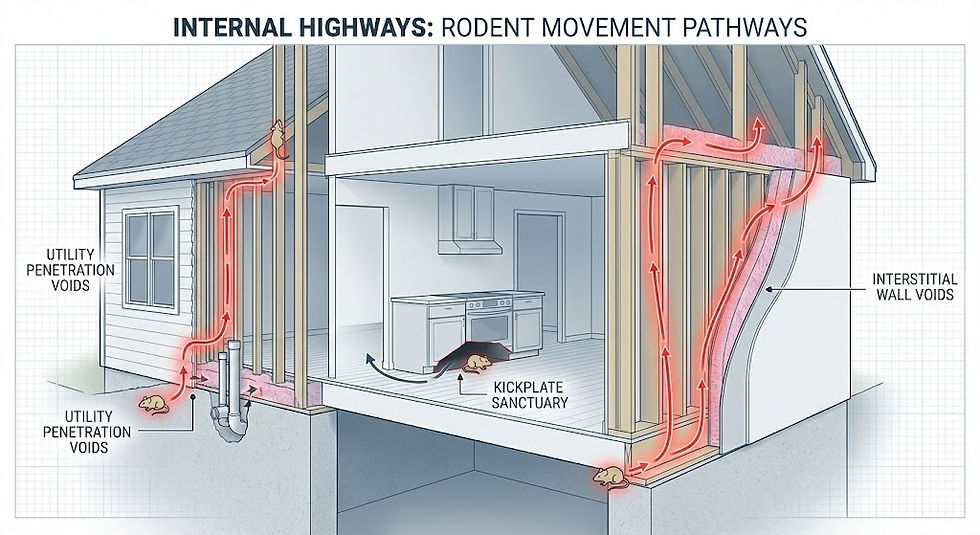
Navigating the "Internal Highways"
Once inside, rodents rarely cross open floors—a behavior known as thigmotaxis, where they maintain contact with vertical surfaces to feel secure. Instead, they utilize the "internal highways" of modern construction:
Utility Penetrations: The gaps around HVAC lines, gas pipes, and electrical conduits.
The Kickplate Sanctuary: The dark, recessed void beneath kitchen cabinets that offers immediate access to food and moisture.
Wall Voids: The interstitial spaces between drywall and exterior sheathing that allow transit from the basement to the attic without human detection.
The Cost of Invisibility: Structural and Health Risks
When rodents occupy these hidden zones, the damage is cumulative, compounding silently over the winter months. Because they are "Invisible Invaders," the risks are often dangerous before they are ever visible to the naked eye.
1. The Fire Hazard of Constant Gnawing
Rodents are classified as "Structural Saboteurs" for a biological reason: their incisors are open-rooted, meaning they never stop growing. To prevent these teeth from curving back into their jaw, they must gnaw daily on high-density materials. Inside your home’s wall voids, this often involves stripping the thermoplastic insulation from electrical wiring. This exposure of live copper creates short circuits and is a primary, often overlooked cause of "undetermined" structural fires in Central Ohio.

2. Destruction of the R-Value and Pheromone Signaling
The attic is a primary "Vulnerability Zone" where the damage is two-fold. First, rodents utilize insulation as both a thermal nest and a latrine. Their waste saturates fiberglass and cellulose, causing the material to lose its "loft" and compress. This destroys the R-value (insulative capacity) of your home, leading to significant energy loss.
Second, this saturation creates a permanent pheromone signature. Even if the initial invaders are removed, the scent remains embedded in the structure, acting as a biological beacon that attracts future generations of rodents to the same entry points next season.
3. Pathogen Transmission through "Delayed Evidence"
Homeowners rarely catch rodents in the act; instead, they find "delayed evidence." By the time you notice pheromone-heavy rub marks (greasy smudges) along a baseboard or a musty odor near a pantry, the environment is likely already contaminated with:
Salmonellosis: Contracted through contact with surfaces where rodents have foraged.
Hantavirus: A severe respiratory disease spread when nesting materials in attics or crawlspaces are disturbed and the virus becomes aerosolized.
Leptospirosis: A bacterial infection spread through contact with water or soil contaminated by rodent urine, which often leaks through ceiling voids from infested attics.
Defending Against Invisible Invaders in New Albany: The 3.S Protection Strategy
At Home Guard IPM, we move beyond the reactive "trap and bait" cycle of traditional pest control. Our approach is rooted in technical mastery and the permanent fortification of your home’s structural envelope.
Smarter: Intelligence-Driven Care
Effective rodent management begins with forensic analysis, not guesswork. Using the 3.S framework, we identify the "hidden highways" unique to Central Ohio architecture. We utilize biological source targeting to track active runways and identify the specific thermal leak points where rodents are gaining ingress. By understanding the why behind the movement, we can implement a more precise solution.
Stronger: The Structural Shield (Exclusion Mastery)
True fortification is built on exclusion—denying the invader entry to the thermal envelope in the first place. While DIY expanding foam is easily breached by rodent incisors, our professional Structural Shield utilizes industrial-grade materials designed for longevity:
Galvanized Hardware Cloth: Custom-fitted to secure crawlspace vents, soffits, and chimney caps.
Metallic Meshes & Elastomeric Sealants: We use a combination of copper or steel mesh embedded with specialized sealants to permanently close utility penetrations.
Reinforced Door Sweeps: Eliminating the "light gaps" at the base of garage and entry doors that serve as invitations for nocturnal foragers.
Safer: Targeted Protocols for Family Wellbeing
Our commitment to safety means we prioritize placement over volume. Rather than "broadcasting" materials across your living spaces, we utilize targeted applications of specialized materials—often botanical-based upon request—placed directly into the inaccessible voids where rodents congregate. This maximizes impact on the "Invisible Invaders" while maintaining the highest safety standards for your family and pets.

Summary: From Sanctuary to Fortress
Protecting against invisible invaders like rodents in New Albany and the rest of Central Ohio is not a seasonal task; it is an essential pillar of home stewardship. By understanding the thermal dynamics of your property and the biological drives of these invaders, you can transition your home from a vulnerable "Thermal Sanctuary" to a fortified structure.
Don't wait for the "phantom noises" in your ceiling to become a structural crisis. Secure your family's legacy by moving from reactive treatments to proactive fortification. Review our comprehensive checklist on Invisible Invaders and contact Home Guard IPM today to schedule a 3.S Protection Audit for your property.

Comments